A Novel Green and Efficient Strategy for Natural Products by Extraction with Acidic Electrolytic Oxidation Water-Assisted Deep Eutectic Solvent
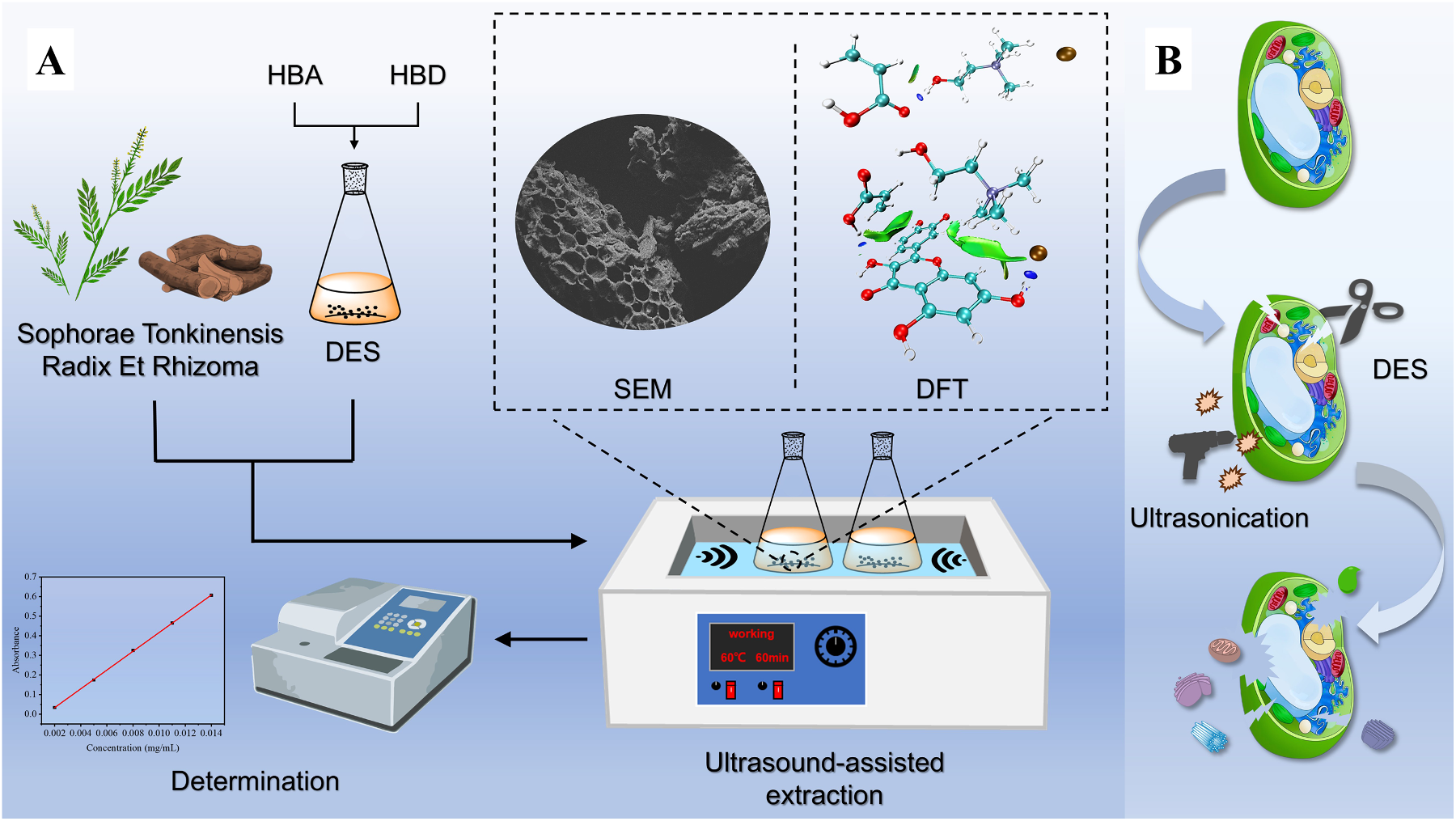
What if the secret to greener plant extraction lies in a solvent that's as simple as it is powerful? Scientists have found a way to pull out flavonoids using a deep eutectic solvent that outperforms traditional methods by up to 4 times.
In the quest for sustainable plant processing, researchers have turned to deep eutectic solvents (DESs)—a new class of green solvents that are cheap, biodegradable, and tunable. This study focused on extracting total flavonoids from Sophorae Tonkinensis Radix Et Rhizoma (STRR), a traditional medicinal plant. By screening 17 different DESs, the combination of choline chloride and acrylic acid came out on top, especially when paired with ultrasonic assistance.
Through careful optimization using response surface methodology, the team achieved a maximum flavonoid yield of 3.785 mg/g under ideal conditions: 61 minutes, 65°C, and a specific solid-to-liquid ratio. But the real magic was in the numbers. When they measured three key flavonoids—quercetin, rutin, and formononetin—the yields were 2 to 4 times higher than those from methanol or ethanol extracts.
To understand why DESs work so well, the researchers used density functional theory (DFT) to peek at the molecular interactions. They found that hydrogen bonds and van der Waals forces between the DES and the plant compounds drive the extraction. This insight not only explains the efficiency but also opens the door to designing even better green solvents.
This study proves that DES-based extraction is not just an eco-friendly alternative—it's a high-performance one. For the plant industry, this means a path toward cleaner, more efficient production of bioactive compounds, with less environmental impact. The future of green chemistry looks brighter, one flavonoid at a time.
Key Points
- DES with choline chloride and acrylic acid boosts flavonoid yield.
- Optimal extraction: 61 min, 65°C, 1:148 g/mL ratio.
- DFT reveals hydrogen bonding and van der Waals forces.
Comments
No comments yet — be the first.