Anthocyanic Vacuolar Inclusions: From Biosynthesis to Storage and Possible Applications
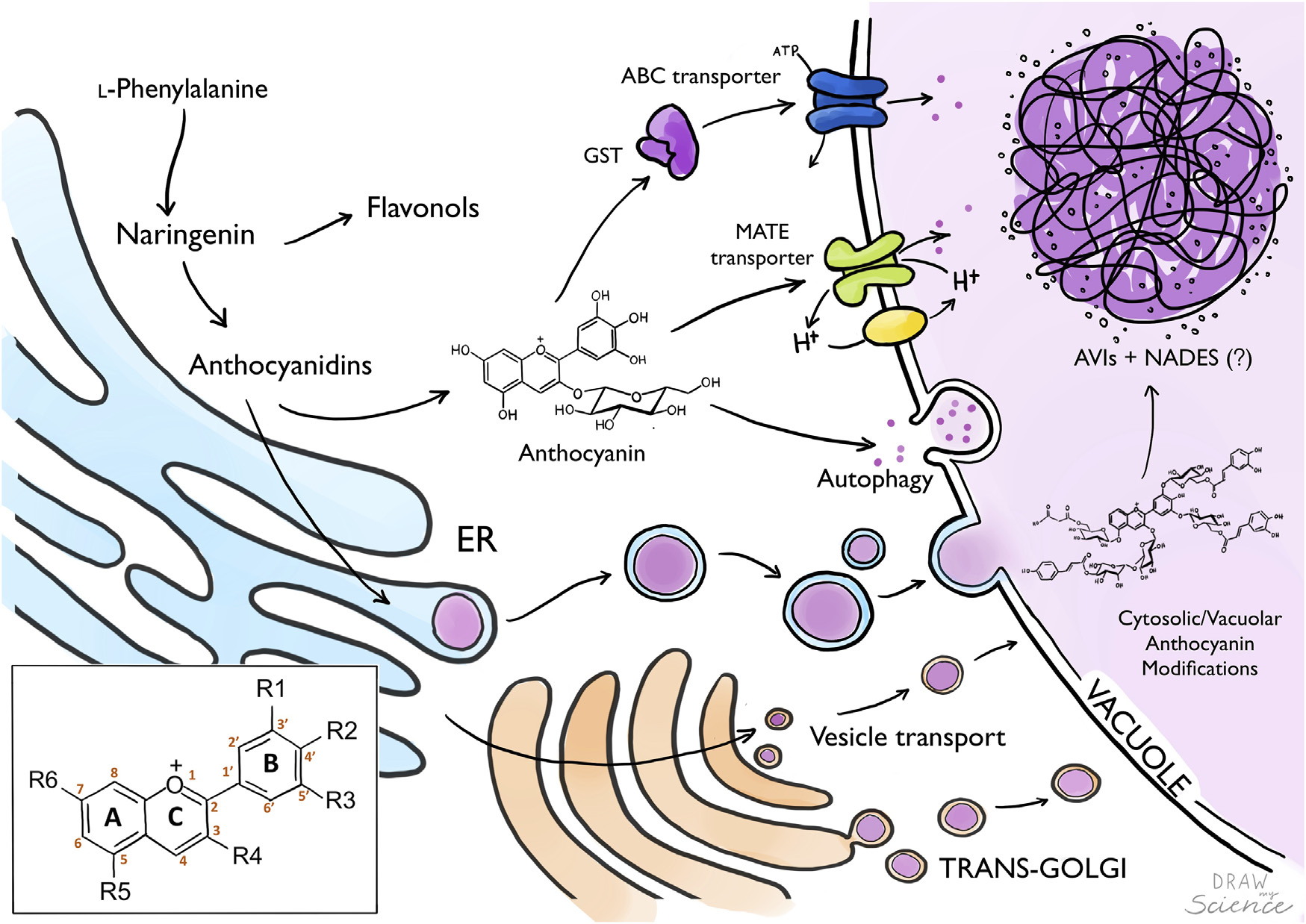
Plants can pack massive amounts of color into tiny spaces—how do they do it? The answer may lie in a mysterious liquid state called NADES.
Plants are master chemists, producing vibrant pigments like anthocyanins that paint fruits and flowers in shades of red, purple, and blue. But these molecules are not just for show—they also protect leaves from UV damage. The challenge? Anthocyanins are poorly soluble in water, yet plants store them in massive concentrations inside vacuoles. How? Enter Natural Deep Eutectic Solvents (NADES): mixtures of natural compounds that form a viscous liquid, capable of dissolving high amounts of these pigments while keeping volatile compounds locked in. This liquid phase, held together by hydrogen bonds, may act as an inert solvent that allows anthocyanins to accumulate in dense, organized inclusions. In this mini-review, researchers explore how modified anthocyanins are synthesized, transported, and stored in these phase-separated droplets. They also highlight exciting applications: by mimicking NADES in synthetic biology, we could produce valuable compounds that are otherwise limited by poor solubility, toxicity, or instability. The humble plant cell might just inspire the next big breakthrough in biotechnology.
Key Points
- NADES are hydrogen-bonded viscous liquids solubilizing high amounts of natural products.
- Anthocyanins form concentrated inclusions in vacuoles, possibly using NADES as inert solvent.
- NADES-derived compartments could aid synthetic biology production of valuable compounds.
Comments
No comments yet — be the first.