Comparative optimization of microwave and ultrasound assisted extraction of pine nut skin bioactives and its application as a natural coating to prevent lipid oxidation in pine nuts
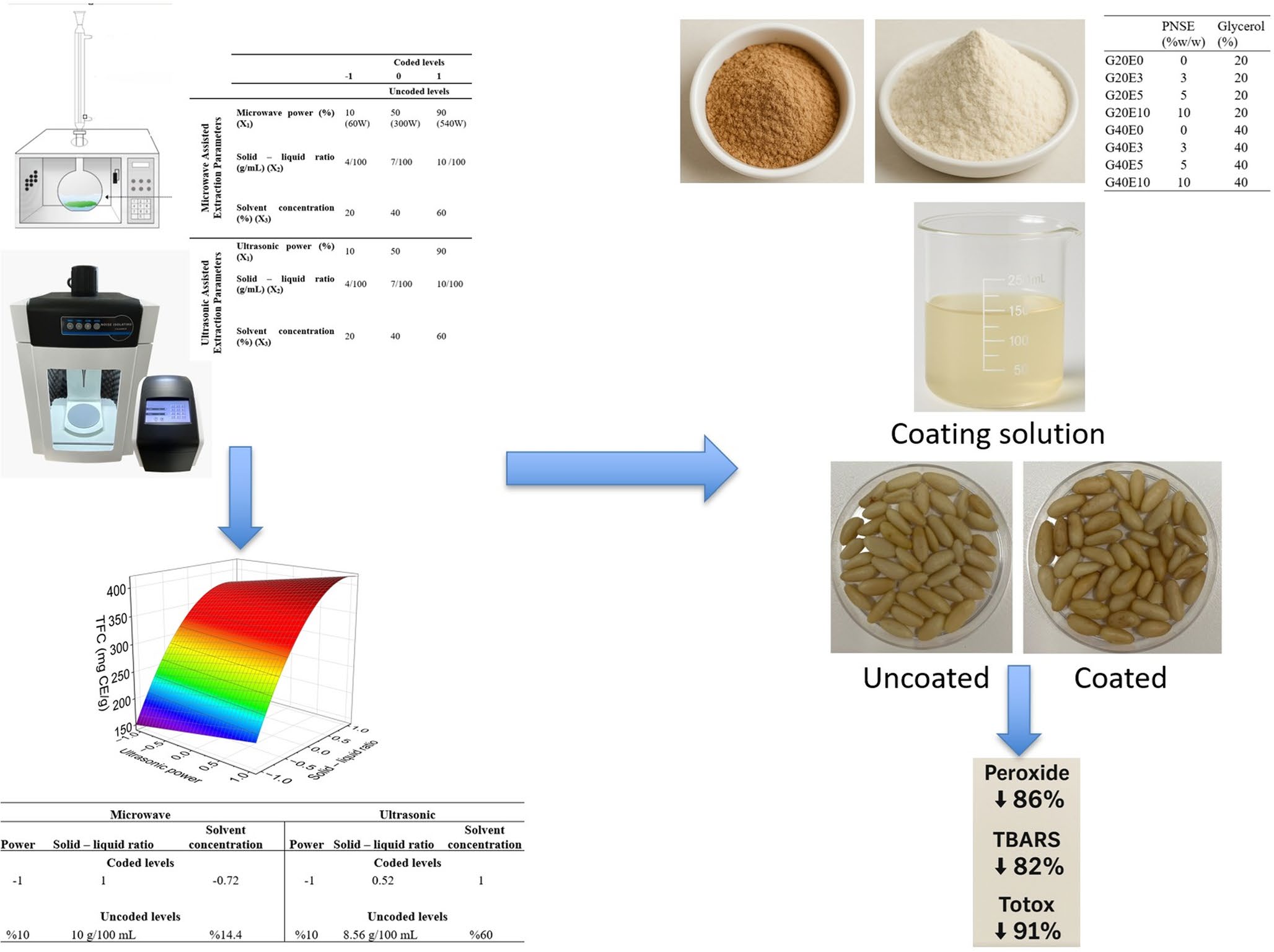
What if the secret to keeping pine nuts fresh lies in their own discarded skin? A new study shows that a natural coating made from pine nut skin extract can slash lipid oxidation by up to 91%.
Pine nut skins are often tossed aside as waste, but they're packed with bioactive compounds waiting to be unlocked. Researchers compared two green extraction methods—microwave-assisted (MAE) and ultrasound-assisted (UAE)—to see which one better recovers these valuable phenolics. The winner? UAE, which delivered a significantly higher total phenolic content (835.15 mg GAE/g) and antioxidant activity (76.27%) under optimized conditions: 10% ultrasonic power, a solid-liquid ratio of 8.56 g/100 mL, and 60% ethanol.
But the study didn't stop at extraction. The team applied the optimized extract as an edible coating to postharvest pine nuts, mixing it with glycerol to create nine different formulations. Through accelerated storage tests, they tracked oxidation markers like peroxide value, TBARS, and Totox value. The standout was the G20E10 coating, containing 10% extract and 20% glycerol, which dramatically slowed oxidation.
Compared to uncoated nuts, G20E10 reduced increases in peroxide, TBARS, and Totox values by roughly 86%, 82%, and 91%, respectively. This natural barrier not only curbed lipid oxidation but also helped maintain overall quality. The findings point to a simple, sustainable way to extend the shelf life of pine nuts—turning waste into protection.
Key Points
- UAE outperforms MAE in phenolic and antioxidant recovery.
- G20E10 coating cuts peroxide, TBARS, Totox by 86%, 82%, 91%.
- Natural pine nut skin coating prevents lipid oxidation.
Comments
No comments yet — be the first.