Green Sequential Extraction of Carotenoids and Coproducts from Invasive Alien Plants and Non-Edible Agricultural Residues
What if the weeds invading your backyard could become a treasure trove of natural pigments? Scientists have turned to invasive plants and agricultural waste as surprising new sources of carotenoids—potentially replacing marigold farms that compete with food crops.
Carotenoids—the vibrant pigments behind the orange of carrots and the yellow of marigolds—are big business. But producing them from dedicated crops requires land and water that could otherwise grow food. This study flips the script: why not harvest these valuable compounds from plants we're already trying to get rid of? Researchers screened eleven invasive alien plants and non-edible agricultural residues, finding carotenoid levels up to 126 mg per 100 g of dry weight, with lutein as the star player, mostly in its free, easily absorbed form.
To extract these pigments, the team turned to a green solvent: a natural deep eutectic solvent (NaDES) made from thymol and coumarin. Using Japanese knotweed leaves as a test case, they found that NaDES4 outperformed traditional acetone, pulling out more lutein (84 ± 6 vs. 56 ± 7 mg/100 g DW) and β-carotene (27 ± 2 vs. 20 ± 2 mg/100 g DW) under gentle stirring at 25 °C.
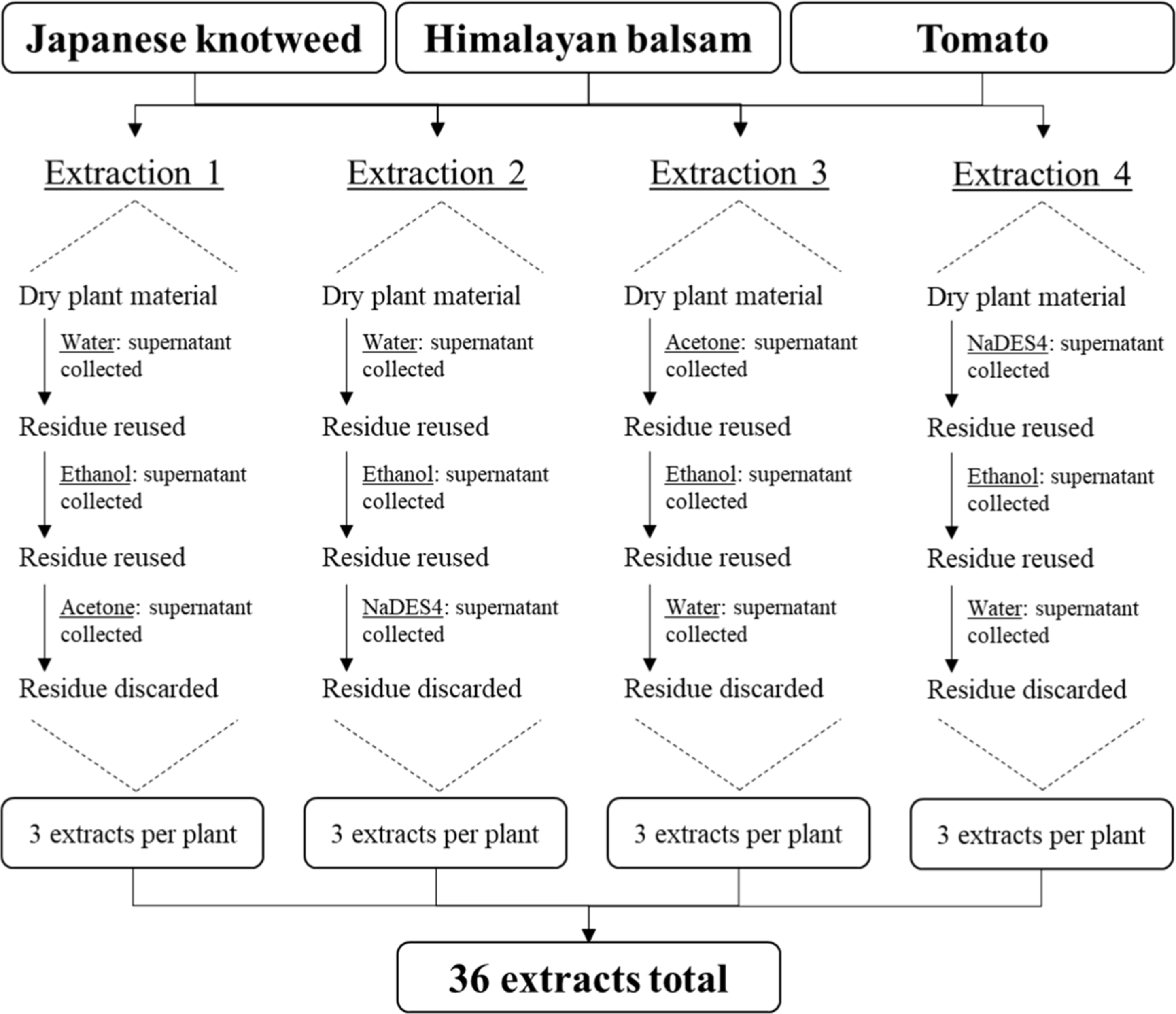
But the innovation didn't stop at extraction. By sequencing the process—first water, then ethanol, then acetone or NaDES4—they recovered not just carotenoids, but also carbohydrates and polyphenols, boosting total carotenoid yield by up to 90% when nonpolar steps came first. The approach is a model of circular economy: one plant, multiple products, zero waste.
Of course, safety matters. The team checked for pesticides and found none above detection limits, but 11 of 22 hydrophobic extracts exceeded EU limits for PAHs, depending on where the plants were collected. That's a reminder: even green solutions need careful sourcing. Still, this work shows that invasive species and vegetable scraps could help meet our carotenoid needs without stealing from our plates.
Key Points
- Carotenoids up to 126 mg/100 g DW in invasive plants
- NaDES4 outperforms acetone for lutein and β-carotene extraction
- Sequential extraction boosts carotenoid yield by up to 90%
Comments
No comments yet — be the first.