Hesperidin from Citrus Processing By-Products: Integrated Strategies from Extraction to Downstream Separation
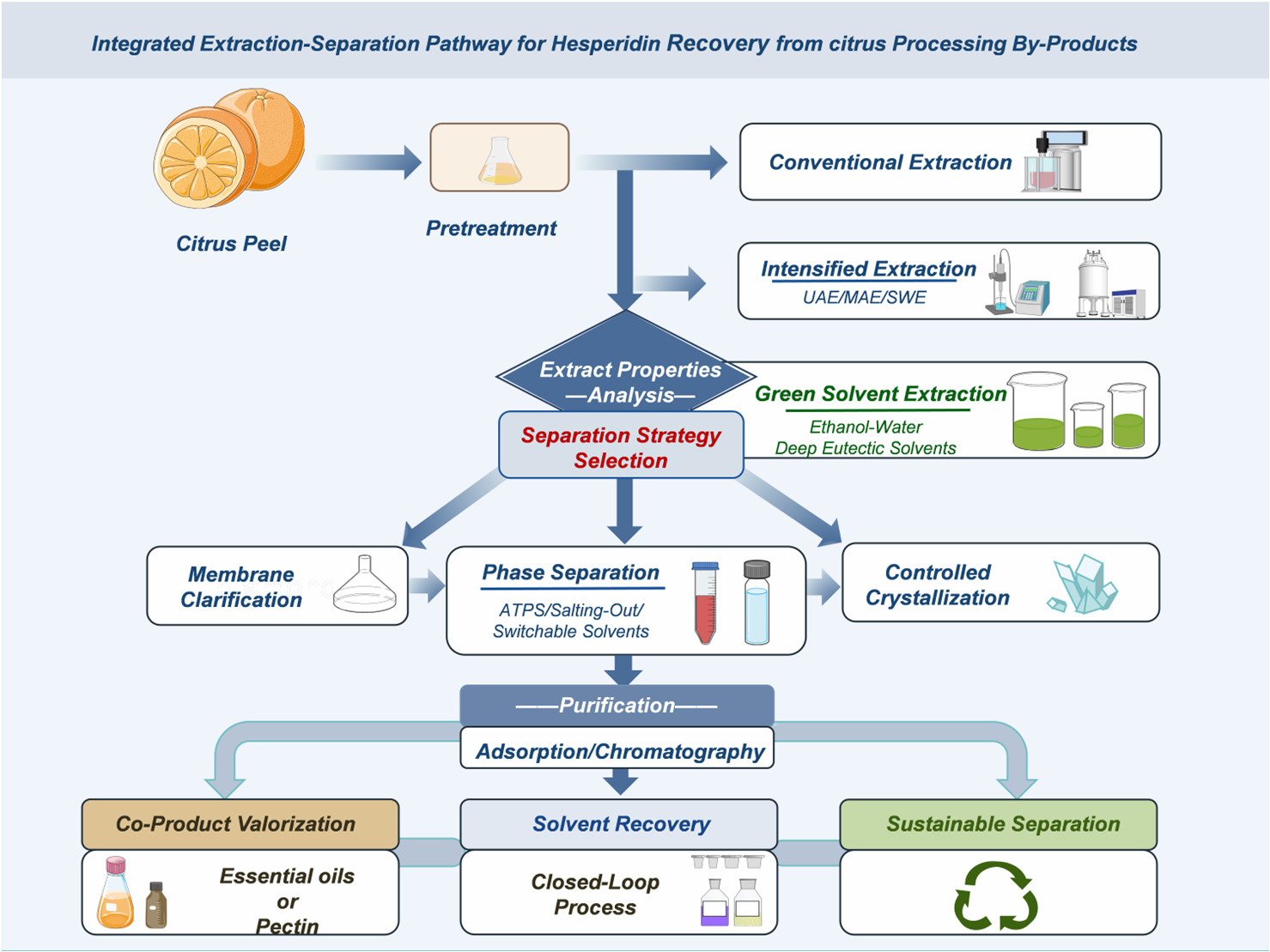
Citrus peels are not waste—they are a treasure trove of health-boosting compounds. But unlocking one of their most valuable molecules, hesperidin, is a puzzle that demands clever engineering.
Every year, millions of tons of citrus fruits are squeezed for juice, leaving behind peels and pulp that are often discarded. Yet these by-products hide a valuable gem: hesperidin, a flavonoid glycoside with promising bioactivity. Extracting it, however, is no simple feat. Hesperidin loves to cling to chemically similar flavonoids, making separation a stubborn challenge.
Most studies so far have treated extraction and purification as separate battles. But this review shifts the perspective: it argues that the choices made during extraction directly influence how hard downstream separation will be. A messy extract with many similar compounds will demand more aggressive purification. The authors systematically compare strategies—adsorption, liquid-liquid partitioning, crystallization, and chromatography—weighing their mechanisms and how well they fit into an integrated process.
The verdict? Solubility-driven crystallization and membrane-based clarification shine for large-scale operations, while adsorption and chromatography excel as polishing steps. The review also highlights key controls for green integration: recycling solvents, managing matrix complexity, and reducing early-stage loads. This is a roadmap for turning citrus waste into a sustainable source of high-value molecules.
Key Points
- Hesperidin from citrus by-products is valuable but hard to purify.
- Extraction choices directly affect downstream separation difficulty.
- Crystallization and membranes suit large scale; adsorption and chromatography polish.
Comments
No comments yet — be the first.