Single factor effect of natural deep eutectic solvent citric acid-glucose based microwave-assisted extraction on total polyphenols content from mitragyna speciosa Korth. Havil Leaves
What if the key to unlocking a plant's healing power lies in a green, sugar-based solvent and a microwave? This study reveals how a natural deep eutectic solvent can efficiently extract polyphenols from a traditional Indonesian herb.
In the quest for greener chemistry, researchers are turning to natural deep eutectic solvents (NADES) as eco-friendly alternatives to traditional extraction methods. This study focuses on Mitragyna speciosa, a plant native to East Kalimantan, traditionally used to treat headaches and inflammation. However, the plant also has addictive properties, making it a compound of interest for careful study.
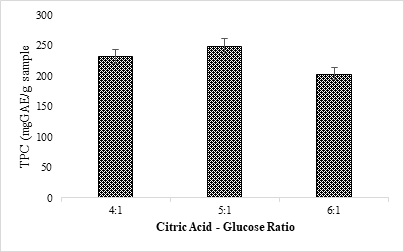
The team used a NADES made of citric acid and glucose, combined with microwave-assisted extraction (MAE), to pull out total polyphenols from dried leaves. They tested different conditions: NADES ratios (4:1, 5:1, 6:1 g/g), solid-liquid ratios (10:1, 15:1, 20:1 mL/g), microwave power (90, 270, 450 W), and extraction times (15, 20, 25 min). The polyphenol content was measured using the Folin-Ciocalteau method, with absorbance read at 746 nm.
Results showed that the best conditions varied by factor: a NADES ratio of 5:1 yielded 248.69 mg GAE/g, a solid-liquid ratio of 15:1 gave 146.93 mg GAE/g, a microwave power of 270 W produced 192.20 mg GAE/g, and an extraction time of 15 minutes resulted in the highest yield of 358.59 mg GAE/g. These findings highlight how each factor independently influences extraction efficiency, offering a pathway to optimize green extraction processes.
Key Points
- NADES citric acid-glucose with microwave extraction yields polyphenols.
- Best NADES ratio: 5:1, giving 248.69 mg GAE/g.
- 15 min extraction time gives highest TPC at 358.59 mg GAE/g.
Comments
No comments yet — be the first.